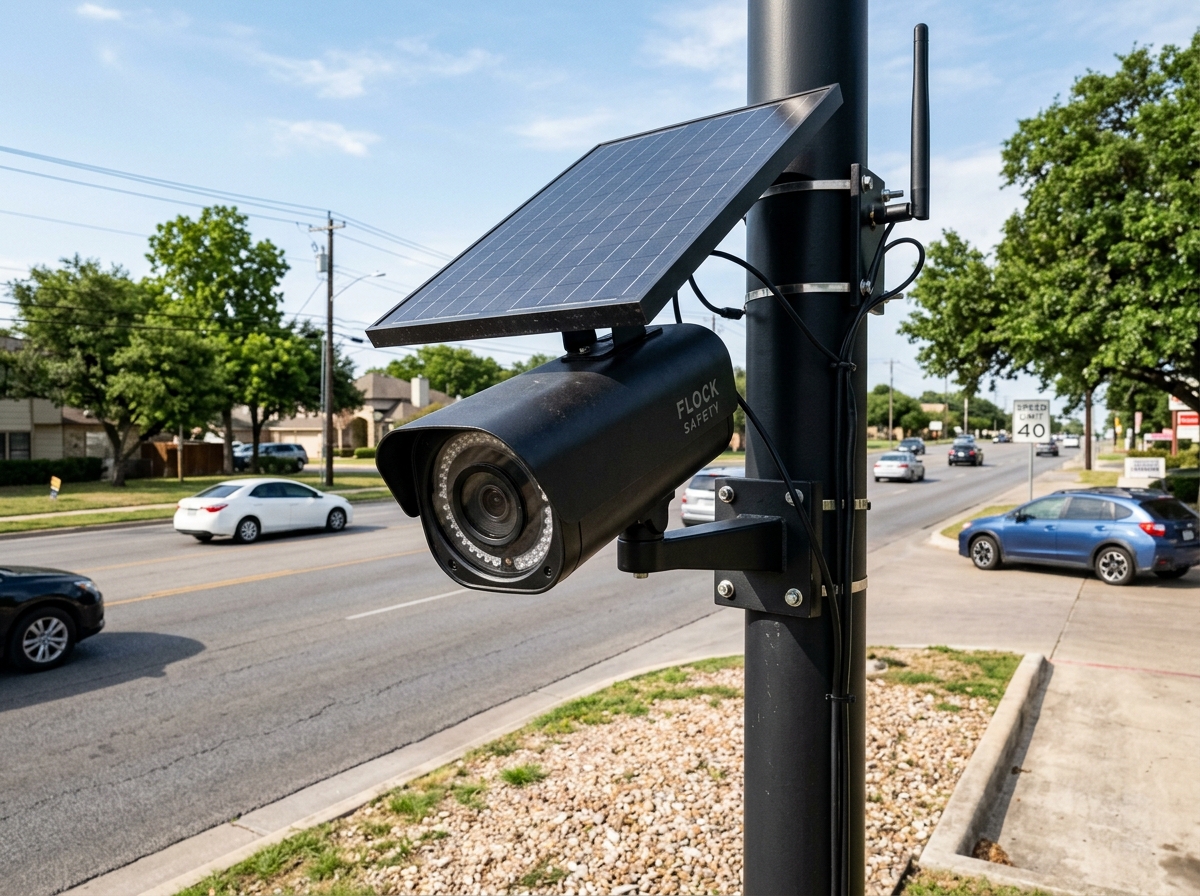
Flock Cameras in Your Neighborhood: Ownership, Capture Data & Civil Rights
When residents spot a new automated license plate reader on their street, they frequently wonder:Who paid for this camera? What data is being collected about my family? Does the police department have continuous access to my daily routine?Below is an exhaustive, practical guide answering these questions and providing actionable tools for conducting a neighborhood surveillance audit.
01.The Anatomy of a Local Neighborhood Surveillance Grid
Automated license plate readers are no longer confined to major interstate freeways and border checkpoints. Over the last four years, Flock Safety pioneered a suburban sales strategy that saturates quiet residential streets:
Subdivision Entrance Choke Points
Most modern suburban subdivisions have only one or two vehicular entrances and exits. By placing a Flock Falcon unit at each ingress point, an entire community of 500+ homes can be completely tracked with just two cameras, recording every resident, visitor, mail carrier, and delivery vehicle.
The "Virtual Gate" Doctrine
Rather than building expensive physical security guard shacks or physical mechanical gates, HOAs market Flock cameras to homeowners as an automated "virtual gate." Instead of keeping strangers out, it creates an indelible digital log of who entered and departed.
Commercial Retail Ingress Plazas
Grocery stores, pharmacies, big-box retailers (The Home Depot, Lowe's, Walmart), and strip shopping centers frequently install Flock cameras at driveway entrances to detect vehicles associated with shoplifting hotlists.
School Zones & Municipal Borders
Local police departments install cameras along school pick-up corridors and municipal boundary streets to establish inter-jurisdictional perimeter alerts when a vehicle leaves one city and enters another.
02.Who Owns the Camera Near You? Public Police vs. Private HOA Systems
Determining whether a camera near your home is operated by your local police department or your Homeowners Association is crucial for understanding your privacy rights:
When a private Homeowners Association or business signs a contract with Flock Safety, they typically enable the TALON network. This feature automatically federates private camera footage directly into the dispatch terminals of local municipal police departments and county sheriffs. Consequently, even though public tax dollars did not purchase the camera, law enforcement officers can query who visited your home without obtaining a Fourth Amendment warrant or complying with municipal surveillance transparency ordinances.
03.What Data Does a Flock Camera Near You Capture?
Every time a vehicle passes within the optical vision cone of a Flock camera, the unit executes edge computer vision analytics powered by an Ambarella CV25 SoC. Within milliseconds, it generates a structured data packet containing:
Plate Alphanumerics
Full license plate characters, state of issuance, and classification of temporary, paper, or vanity plates.
Vehicle Fingerprint™
Make, model, color, roof racks, bumper stickers, hitch mounts, window decals, and exterior alterations.
Telemetry & Heading
Exact GPS coordinate timestamp, vehicle lane, travel direction azimuth vector, and estimated traffic speed.
04.Step-by-Step Guide: Conducting a Neighborhood Surveillance Audit
If you want to know how many surveillance cameras monitor your community, follow this proven 5-step citizen auditing methodology:
Conduct a Physical Roadside Walk Audit
Walk or cycle through all vehicular ingress and egress routes of your subdivision. Inspect utility poles, median landscaping, and streetlight uprights for thin black poles paired with solar panels tilted at 30°–45°.
Review HOA Board Minutes & Budget Statements
Request copies of your HOA's annual operating budget and meeting minutes. Look for vendor line items payable to "Flock Group Inc" or recurring annual line items of $2,500 to $3,000 per camera listed under "Community Security."
Mine City Council Agendas & Master Agreements
Search your city clerk's legislative portal for keywords like "Flock Safety," "Automated License Plate Reader," or "ALPR Master Services Agreement." Council resolutions frequently attach installation schedules and intersection lists.
Submit a Local Public Records Request (FOIA)
File a state public records request with your local police department requesting all Memorandums of Understanding (MOUs) between the police department and local HOAs regarding shared ALPR camera networks.
Contribute Unmapped Cameras to OpenStreetMap
Using mobile mapping applications like Every Door or Go Map!!, photograph and tag the camera node on OpenStreetMap so it is indexed on FlockCamerasMap for community transparency.
05.Local Deployment Capture Geometry & Specifications Matrix
Roadside camera deployments differ significantly in installation height, capture distance, and operational scope:
| Deployment Type | Mounting Height | Capture Distance | Speed Limit Rating | Primary Operating Entity |
|---|---|---|---|---|
| Subdivision HOA Gate | 10 to 12 feet | 30 to 50 feet | Up to 35 mph | HOA Board / Private Security |
| Municipal Arterial Intersection | 12 to 14 feet | 50 to 75 feet | Up to 55 mph | Municipal Police Department |
| Freeway Off-Ramp Deceleration | 14 to 18 feet | 75 to 100 feet | Up to 75 mph | State Highway Patrol / Sheriff |
| Commercial Strip Mall Parking | 12 to 15 feet | 40 to 60 feet | Up to 25 mph | Retail Property Management |