What Is a Flock Camera? Complete Technical, Hardware & Operational Guide (2026)
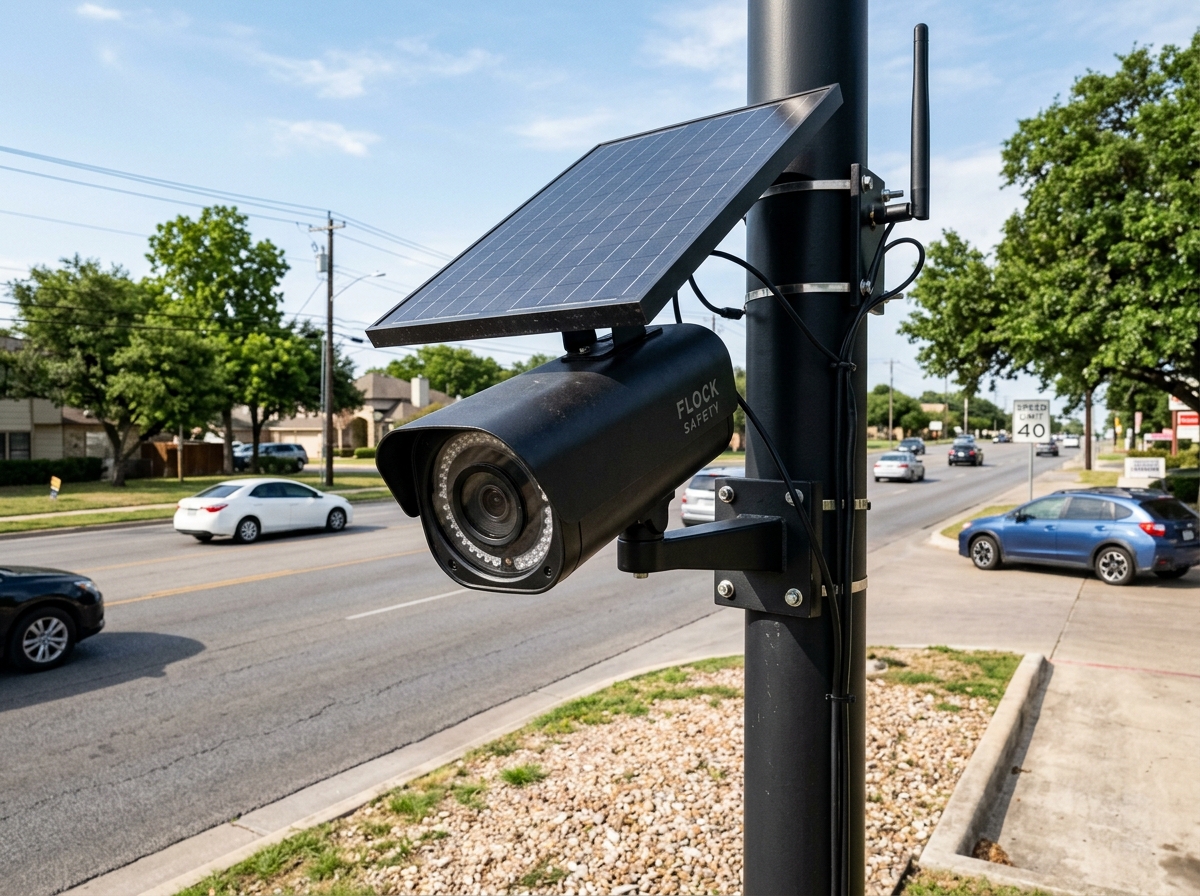
Immediate Answer: What Is a Flock Camera?
A Flock camera is an automated license plate reader (ALPR) manufactured by Flock Safety, an Atlanta-based public safety technology firm founded in 2017 by Garrett Langley. Unlike traditional closed-circuit television (CCTV) cameras that stream continuous live video, Flock cameras are motion-triggered still photography devices designed to capture high-resolution images of vehicle license plates and physical traits as cars travel past public roadways, neighborhood entrances, and highway corridors.
The company's flagship hardware device, the Flock Falcon, is completely self-sufficient. It operates on an overhead solar panel and an internal rechargeable battery, communicating with Amazon Web Services (AWS) GovCloud via encrypted cellular LTE. This infrastructure-free footprint allows municipalities, police departments, and private homeowners associations (HOAs) to deploy surveillance grids across thousands of intersections without trenching electrical power lines or installing fiber optic cables.
Today, over 5,000 law enforcement agencies and more than 3,000 private homeowner associations utilize Flock Safety systems, logging billions of vehicle scans per month into an interconnected, searchable cloud database.
Historical Genesis: The Rise of Neighborhood & Highway ALPR Grids
Historically, automated license plate recognition was restricted to specialized law enforcement equipment. Traditional systems—manufactured by vendors such as Motorola Solutions (Vigilant Solutions) and Leonardo (ELSAG)—required bulky roof-mounted cameras installed on police cruisers costing $15,000 to $25,000 per patrol car, or heavy overhead gantries on tollways.
In 2017, Flock Safety fundamentally disrupted the municipal surveillance marketplace:
- Low Subscription Cost: Instead of selling expensive capital hardware, Flock introduced a Hardware-as-a-Service (HaaS) subscription model priced between $2,500 and $3,000 per camera per year.
- Standalone Solar Architecture: By eliminating the need for city utility hookups, cameras could be installed on a roadside pole in under 60 minutes.
- Federated Private-Public Sharing: Flock enabled private subdivision HOAs to buy cameras and voluntarily share live feeds with local police departments, creating a sprawling public-private surveillance web.
Hardware Blueprint: What's Inside the Matte Black Falcon Cylinder?
Every standard Flock Safety Falcon installation comprises five core physical components:
- Dual-Sensor Optical Assembly:
- High-Resolution Color CMOS Sensor: A 5-megapixel optical sensor dedicated to capturing vehicle body color, make, model, bumper stickers, and cosmetic alterations in daytime lighting.
- Monochrome Retroreflective Infrared (IR) Sensor: A specialized sensor optimized for the 850nm infrared spectrum that captures license plate characters in complete darkness or bright headlight glare.
- 850nm Infrared Illuminator Array:
- A ring of high-efficiency infrared LED emitters encircling the camera lens.
- Operates just outside the human visible spectrum (faint dull red glow visible only in pitch darkness directly in front of the lens).
- Flashes imperceptibly when a vehicle approaches, reflecting off retroreflective license plate paint without blinding motorists.
- Embedded Edge AI Compute Module:
- Powered by low-power edge processors (such as the Ambarella CV-series vision chip).
- Runs on-device machine learning models to detect vehicle bounding boxes, license plate locations, and alphanumeric character extraction before cloud transmission.
- Photovoltaic Solar Collector & LiFePO4 Battery:
- A 20W to 40W monocrystalline solar panel mounted 1 to 2 feet above the camera head, angled 30° to 45° south/southwest.
- Internal lithium-iron-phosphate (LiFePO4) battery pack engineered to sustain 72+ hours of autonomous operation through overcast or stormy weather.
- Integrated 4G LTE Cellular Modem:
- Internal multi-carrier cellular antenna providing encrypted TLS 1.3 connectivity to AWS GovCloud.
- Payloads are uploaded within 1.5 to 2 seconds of detection.
- Optical Motion Trigger: As a car enters the camera's calibrated focal field (typically 50 to 75 feet away across 1 to 2 lanes), edge computer vision detects vehicular motion.
- Dual-Exposure Image Capture: The camera fires simultaneous daylight RGB and infrared exposures to capture both the vehicle chassis and the reflective license plate.
- On-Device Optical Character Recognition (OCR): The internal processor extracts plate characters and issuing state or province.
- Vehicle Fingerprint™ Trait Extraction: Machine learning algorithms categorize vehicle color, make, model type, roof racks, paper temporary tags, and distinguishing cosmetic damage.
- Encrypted Cellular Transmission: The metadata payload and compressed thumbnail images are transmitted over LTE to AWS GovCloud.
- Hotlist Matching & Dispatch Alerting: The cloud server matches the plate against the FBI National Crime Information Center (NCIC), state stolen vehicle registries, amber alerts, and local police BOLO lists. If a match occurs, an audio chime and GPS location ping are broadcast to patrol car mobile data terminals (MDTs) in under 3 seconds.
- Alphanumeric Plate & State: Plate number and issuing state (e.g., Texas, California, Georgia).
- Plate Type & Alterations: Identifies paper dealer tags, out-of-state plates, missing front plates, and motorcycle tags.
- Vehicle Color: Categorized into primary color classifications (white, black, silver, red, blue, green, etc.).
- Vehicle Make & Model: Deep neural networks identify manufacturer and body style (e.g., Ford F-150, Honda Civic sedan).
- Unique Identifying Alterations: Detects roof racks, bumper stickers, decals, trailer hitches, tinted windows, custom wheels, and dented panels.
- Directional Azimuth & Speed Heading: Logs the exact second and compass travel heading (0°–359°).
- No Certified Radar / LiDAR Hardware: Automated speed enforcement requires certified Doppler radar, laser sensors, or underground piezoelectric road loops calibrated to strict legal evidentiary standards. Flock Falcon units lack this hardware.
- Statutory Legal Prohibitions: In many states (such as Texas under Tex. Transp. Code § 707 and California), photographic automated traffic tickets are either strictly banned or heavily regulated.
- Investigative Focus: Flock’s operational mandate is vehicle identification for criminal investigations (stolen cars, kidnapping alerts, felony warrants), not civil municipal traffic enforcement.
- 256-Bit AES Encryption: Data is encrypted at rest and in transit via TLS 1.3.
- Default 30-Day Purge: Under Flock's standard commercial terms, unflagged vehicle scans are automatically deleted after 30 days unless an officer explicitly flags a record as digital evidence in an active felony or misdemeanor investigation.
- Search Justification Audit Logs: Officers must enter an active case number or dispatch reason before querying historical plate records.
- Audit Transparency: Citizens in most states have the legal right under state public records laws to request portal audit logs from their local police department.
Operating Telemetry: The Sub-2-Second Detection Lifecycle
When a vehicle travels past a Flock Safety camera, the system executes an automated 6-stage detection pipeline:
What Vehicle Fingerprint™ Actually Extracts
Flock Safety's patented Vehicle Fingerprint™ software goes far beyond basic license plate reading. Even if a vehicle has missing plates, obscured tags, or paper temporary tags, the system catalogs:
Technical Comparison: Flock Falcon vs Other Surveillance Systems
| Feature | Flock Safety Falcon | Motorola Vigilant L6Q | Genetec AutoVu | Speed / Red Light Camera |
|---|---|---|---|---|
| Primary Purpose | Investigative vehicle search & Hot List alerts | Highway interdiction & high-speed patrol | Parking enforcement & transit surveillance | Automated traffic fine citation |
| Power Footprint | Standalone Solar Panel & Battery | 120V AC or Solar Option | Hardwired AC / PoE | Hardwired 120V/240V Grid |
| Speed Enforcement | No (cannot measure speed for citations) | No (investigative only) | No (parking / access) | Yes (certified Doppler radar / loops) |
| Video Recording | No (still images only) | No (still images only) | Optional video stream | Continuous video buffer |
| Edge AI Capabilities | Vehicle Fingerprint™ (Make, Model, Decals) | Plate OCR only | Dual-lens OCR | Radar trigger only |
| Pricing Model | $2,500 – $3,000 / camera / year SaaS | $15,000 – $25,000 capital purchase | Capital purchase + maintenance | Revenue share or lease |
Enforcement Clarification: Can Flock Cameras Issue Speeding Tickets?
A common public misconception is that Flock cameras are automated speed or red light enforcement cameras. Flock Safety cameras cannot issue speeding tickets or traffic fines.
Here is why:
Cloud Architecture, Retention & Data Security
Flock Safety stores all vehicle capture data on Amazon Web Services (AWS) GovCloud, an isolated cloud region compliant with the FBI Criminal Justice Information Services (CJIS) security policy.
Key data governance rules:
Explore These Cameras On The Live Map
Search your state or city to see verified camera locations and vision cones in real time.
Frequently Asked Questions
Common questions addressed in this guide.